The elders in the village of Kapombe, a dusty fissure in the Central Region of the Republic of Weusi, would sit still under the timeless Baobab trees when the dust storms allowed it. To the village children, their stories sounded like impossible folklore, tales of a mythical paradise. They sang songs of “The Golden Maize Era,” describing an age when maize stretched across the horizon like a yellow sea, glistening under reliable rains, feeding millions with heavy, yellow kernels. But that gold proved to be a facade; it was soft, chemically dependent, and shallow-rooted.
It was the year 3056, and the global soil crisis had reached its peak, and the gold maize fields had withered. Hunger was no longer a statistic in Weusi; it was a constant companion that hollowed out the cheeks of the village children. Water was no longer a resource; it was a memory traded in whispers. The soil, once dark and rich, was now the color of old ash. It had finally surrendered, choked by centuries of intensive tilling, chemical overuse and an obsession with maize. But even in these barren and destitute lands, where the last of the crop had shriveled one crop stood majestic: The Mighty Sorghum.
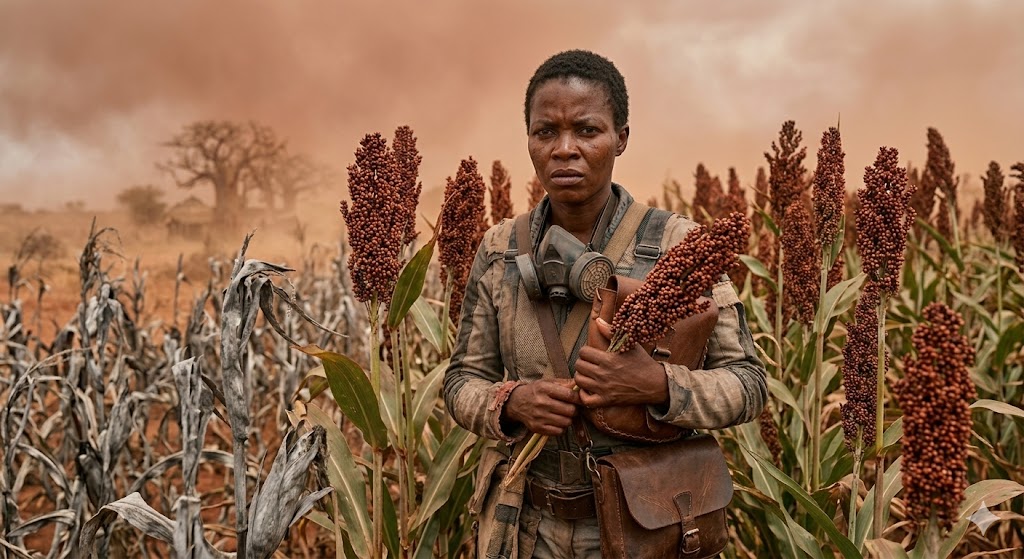
While everything else perished, Sorghum stood tall, its stalks a deep red, crowned with heavy heads of grain that didn’t just survive the heat—they seemed to feast on it. It possessed an ancient intelligence , bypassing the lifeless surface dust to unlock moisture pockets . It was the food of the ancestors, waiting patiently in the soil to save the descendants. Even in the despair that villagers wallowed in mourning the loss of the golden era of maize, a young girl, Assumpta, was determined to bring back the smiles of children and rediscover a new way of life for the village of Kapombe.
Assumpta moved through the Sorghum fields that remained majestic in the dry fields with determination and hope. The villagers watched her with disdain. They called her “The Sorghum Grabber.” It was a title born of observation. While others spent their energy mourning the dead maize, Assumpta worked tireless hours meticulously gathering every stray Sorghum seed that fell from the majestic stalks. She didn’t let a single one hit the parched earth.
“Look at these seeds, this is our future, this is how we survive,” she whispered in a raspy voice to the children who had gathered around her watching her collect the sorghum seeds., As the children “ooh’d” and “aah’d” at her collection of seeds, a massive, dust storm began to gather on the horizon, signalling a three-day lock down. It had not rained in months and dust storms were common, but this storm seemed to be pregnant with the ambition to destroy whatever it found on its path.
Assumpta tightly clutched her leather pouch filled with the seeds she had “grabbed” that day to her chest. She wasn’t looking to the skies for a miracle. She was looking at the ground, preparing for a quiet revolution, rooted in the very dirt everyone else had given up on.